Texas Veterinary Medical Diagnostic Laboratory
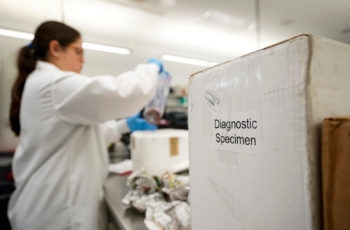
Established in 1967, the Texas Veterinary Medical Diagnostic Laboratory is one of the world’s largest and busiest veterinary diagnostics laboratories. TVMDL is composed of two full-service laboratories, in College Station and Amarillo, and two poultry laboratories in Center and Gonzales.
The TVMDL System remains centered on the following objectives: identifying disease in sick or postmortem animals; facilitating livestock commerce; serving as an animal disease surveillance system for endemic, newly emerging, and high-consequence diseases; and providing support and guidance to public health programs aimed at the control of zoonotic diseases. TVMDL is one of 12 laboratories that form the core of the National Animal Health Laboratory Network (NAHLN).
Spotlights
Texas Animal Health Commission information regarding the presense of Equine Piroplasmosis in South Texas
Information on the Piroplasmosis outbreak can be found by clicking on the above link. Currently all testing for Piroplasmosis must be done at the National Veterinary Services Laboratory in Ames, Iowa. TVMDL is not authorized to provide that test, therefore, please forward specimens directly to NVSL using Federal Submission form, VS Form 10-11, found with the link below. The mailing address for the Laboratory and telephone number can be found on the form.
http://www.aphis.usda.gov/library/forms/pdf/VS_Form10_4.pdf
Accurate and rapid microorganism identification is critical to disease diagnosis and treatment, but many microorganism species cannot be identified through traditional (phenotypic) identification...(read more)
Contagious Equine Metritis (CEM) Testing Information
The College Station and Amarillo laboratories of TVMDL are NVSL-approved CEM testing labs. The following section contains specimen submittal procedures...(read more)
Ivermectin and Silverleaf Nightshade
Ivermectin is approved in horses for the control of: large strongyles (adult) (Strongylus vulgaris, S. edentatus, S. equinus, Triodontophorus spp.), small strongyles, pinworms (adults and 4th stage larva), ascarids...(read more)
Canine Influenza detected in several states
Canine influenza virus is a recently emergent pathogen of dogs that has caused highly contagious respiratory disease in racing greyhounds, pet dogs and shelter animals. The dog flu virus is currently spreading. Canine influenza is now...(read more)
TVMDL Announces New Testing Capabilities for EHD/BTV
Hemorrhagic Disease is an important infectious disease of white‐tailed deer (WTD). Outbreaks occur almost every year in Texas...(read more)
For information on Vesicular Stomatits, a history of the disease in Texas, movement restrictions, etc. please see the Texas Animal Health site below:
http://www.tahc.state.tx.us/animal_health/vs/vs.html#2009VS
For information on the submission process for Vesicular Stomatitis testing by CELISA test run at NVSL see: USDA VS NVSL Vesticular Stomatitis Testing Information
For information on the Vesicular Stomatitis testing requirements for animals going to Kentucky see: Kentucky Vesticular Stomatitis Information
Information Regarding Hemorrhagic Diseases of Deer
Epizootic hemorrhagic disease virus (EHDV), bluetongue virus (BTV) and adenovirus are possible virological causes of a hemorrhagic disease in White-tailed deer (WTD). EHDV and BTV are two closely...(read more)